
Everywhere we see a discussion of affordability. Homes are at record prices. Rents continue to rise. Grocery prices are high. And gas peaked at $4.50 a gallon.
The affordably crisis is a result of worker incomes not keeping up with prices. There would be no affordability issues if wages and worker incomes had kept up with worker productivity and GDP growth. Instead corporations and “capital” collected the growth and productivity benefits. So we have an affordability problem.
Productivity has doubled since 1980 as had GDP growth, but all of the gains have gone to business owners. Workers got short changed. Wages have been flat since the 1980s. The are a lot of reasons for stagnant wages: corporate power, outsourcing, offshoring and immigration. Sadly the amount of money paid to workers has been stagnant since 1973.
The labor share of income started decline in 1973, but the decline has accelerated since the year 2000. The decline shows up in affordability crisis of the current generation.
How do we define labor share of income in the economy
The Gross Domestic Product of the United States has two components: The labor share of income and the capital share of income. The “Labor Share” is the portion of GDP paid as compensation to workers in wages and benefits. The “Capital Share” is the amount of GDP returned to capital owners including owners’ salaries.
Before we tackle labor share of income, we need to look at the current job market. The current labor market is frozen with stagnant hiring. In a stagnant job markets wages fall because of inflation. Wages increase when people move to new jobs.
Labor share of income trends
So today we want to look at the labor share of income from employment. And the picture is grim. Labor share of income has not increased in the US economy since 1973.
The charts speak for themselves so there is not much to add. Please review. We just want to point out that the labor share of income has declined by -12% since 1970, -11% since 2000 and worse -6% since 2020. The trend is accelerating. Half of the loss is since 2020. Yikes.
If we turn to corporate profits, they have increased buy 31% over the same period and continue at the same rate since 2001: 31%.
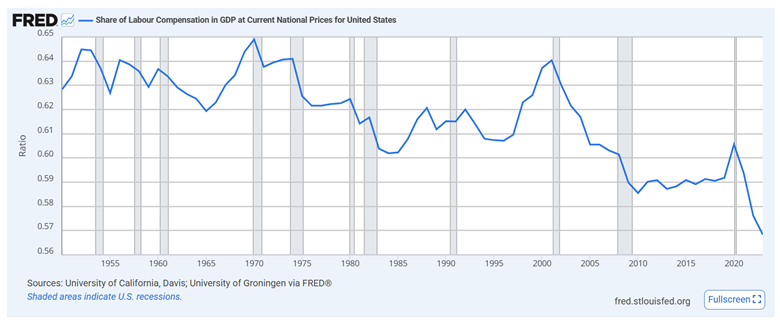
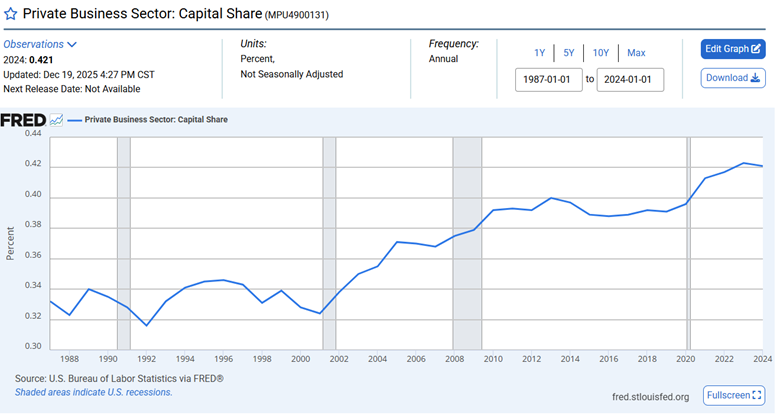
Economists have long noted the trend with little media coverage. It is one of the biggest topics in economics, currently. Labor share of income and it’s twin sister, inequality have preoccupied great economists for decades. Piketty’s break through book finally settled the matter, returns to capital exceed returns to labor in a modern economy. But his book had little consequence in the real world.
Currently there is incredible competition for jobs. Especially good, quality jobs. This competition reduces wages, job quality and benefits for everyone. If you cannot change jobs, you cannot improve your income. Corporations have increasing monopsony power where they control the supply of new jobs.
The reduction in jobs is cause by outsourcing, offshoring, reduced government hiring and automation. The increase is also caused by competition from immigration and corporate cost reductions.
Three big mistakes
The problems of workers in the US economy are structural and long-term. They are the cumulative effect of many decisions made decades ago. The big three mistakes were: financialization, a non-caring, non-activist government, and globalization.
The good news is that there is a solution: Industrial policy. IP would promote policies that help US society. Fair trade policies, limited immigration policies (large and fair), investments in key technologies (green energy, batteries, data centers, high speed rail), education. It would also create a wealth fund to invest in successful companies (miliary, AI, green tech, casinos) that will be successful over time.
So, what were the big mistakes that led to declining labor share of income?
The biggest mistake was the belief in shareholder value. The belief that capital and markets could solve all social problems. Many thought societies would benefit if the principle of shareholder value dominated all corporate decisions. Shareholder value, AKA “Greed is Good.” led to the financialization of the economy. Making money became the preeminent driver of society rather than making things, educating people, helping others, or building communities.
Financialization leads to a constant push for greater corporate profits. The US economy grows at about 3% (GDP), yet corporate profits average 13%. The profits come at the expense of workers. Companies are constantly off shoring, automating, reducing staff or cutting benefits to save costs.
Second, the idea that the government is the enemy and should be limited. In the world dominated by finance and global trade, societies need a counter weight to corporate power. That intuition is the government. Other countries limit corporate power though regulation or societal norms. It is not corporations nor charities nor private individuals acting together. Only collectively action through government can make the large improvements in society that benefit everyone. Government is the largest institution the works to improve society
Finally, globalization. Or off shore manufacturing. Global trade caught everyone off guard. In hindsight it was a disastrous move for workers. It hollowed out manufacturing in the Midwest. It hurt the economics of allies in Latin America leading to immigration. And it led to unbalanced immigration policies in the US that did not match labor demand to wages and incomes of existing workers.
Sure, affordability is a problem, but it hides the real problem: the labor share of income in the economy has dropped dramatically. Affordability is a symptom of short-term, free market thinking without considering the long term impacts.
Summary
So, we would not have an affordability crisis if wages had kept up with prices.
Not much to tell, only an activist government can curb corporate power, stop and claw back outsourcing job losses, limit immigration and increase labor share of income for US workers. For 50 years, we have not had an activist government that puts workers first. So maybe it’s time to try something different. Just saying.
There is a solution: Industrial policy. IP would promote policies that help US society. Fair trade policies, limited immigration policies (large, targeted and fair), investments in key technologies (green energy, batteries, data centers, high speed rail), education (apprenticeships, community colleges) . It would also create a wealth fund to invest in successful companies (miliary, AI, green tech, casinos) that will be successful over time.
Sources
Here are some great resources on labor share of the economy to further understand the issue. Labor share is one of the hottest topics in economics. There were and estimate 12,000 articles written about Labor share.
Estimating the U.S. labor share (Bureau of Labor Statistics), 2017 – The single best article on defining the US labor share of GDP. Widely referenced. Everything you need to know about labor share. The sad part is the article is 30 years old. We all knew what was going on and looked the other way.
The Elusive Explanation for the Declining Labor Share (Annual Review of Economics) – Second best. One of the best reviews of all of the competing theories for the decline of labor share.
The Decline of the U.S. Labor Share (Brookings), 2016 – The offshoring of labor-intensive industries was the primary culprit. Not automation, not union membership.
Perspectives on the Labor Share (AEA), 2024
RECENT DECLINES IN LABOR’S SHARE IN US INCOME: A PRELIMINARY NEOCLASSICAL ACCOUNT (NBER)
The Post‑COVID Decline in the Labor Share (NY Fed) – Good summary. Discusses sector impacts.
Keynes (1939, p. 48) had called “one of the most surprising, yet best-established, facts in the whole range of economic statistics,” namely the “stability of the proportion of the national dividend accruing to labour, irrespective apparently of the level of output as a whole and of the phase of the trade cycle.” Kaldor (1961) famously tagged the constancy of the labor share as the first of his stylized facts about economic growth.