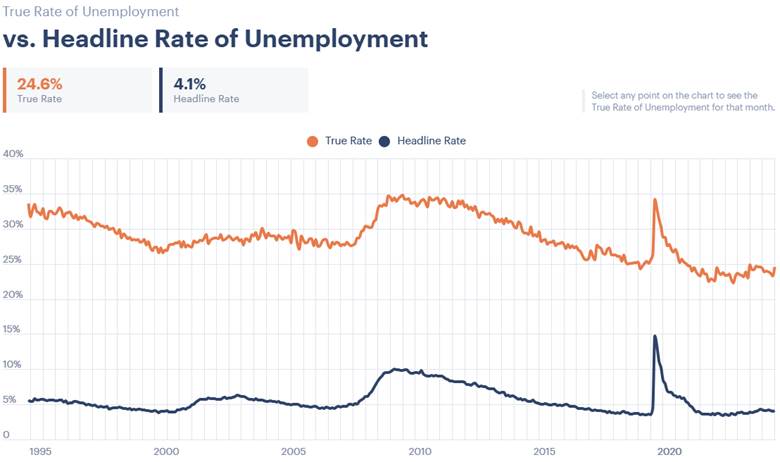
Since Kamala Harris’s narrow defeat in the presidential election, we have been looking at real measures of economic insecurity and prosperity. Voters consistently rank the economy as their top concern, yet traditional economic indicators often fail to capture the full picture.
From time to time here at BlackEconomics.com and our sister blog BlackEconBiz.com, we regularly publish the Black unemployment report. Our report looks in detail at Black employment and unemployment. Our data comes from the monthly unemployment report from the Bureau of Labor Statistics(BLS). We calculate the “Real” Black unemployment rate; lately about 12%. We calculate the Black to white difference between U-3 (the national unemployment rate) and then add it to U-6.
U-3 is defined as the national unemployment rate which is currently about 4%. U-6 is a broader measure of unemployment. The BLS’s U-6 figure is defined as everyone unemployed, then add people who are actively looking for work, plus part-time workers for economic reasons. U-6 is a better measure of the true unemployment rate but still not comprehensive enough.
To get the “real” unemployment or under-employment picture in the United States you have to look at other groups which are not counted. People who are under-employed t or not earning enough. Groups like part-time workers, temporary workers, and low-paid workers. Also people working more than one job to make ends meet.
When you add them all up, the real unemployment rate or under-utilization rate maybe closer to 25%. Luckily, one think tank has already done the work. That think tank is The Ludwig Institute for Shared Economic Prosperity (Lisep.org)
Bureau of Labor Statistics
The Bureau of Labor Statistics has not adapted to the changing employment situation in the United States economy. They still collect the same old statistics. The US economy has changed drastically since the 1980s. We have had financialization, outsourcing and off-shoring, huge growth in part-time workers, and the 2008 mortgage crisis and COVID. Yet the BLS statistics have remained the same.
Given the state of labor market data collection, one think tank has stepped in to provide more accurate numbers: The Ludwig Institute.
Ludwig Institute
The Ludwig Institute has three measures of economic insecurity: The true unemployment rate, the true cost of living, and the true weekly earnings.
- The True Unemployment Rate – Estimated at 24.6%, far above the 4.0% BLS figure. LISEP defines unemployment to include all individuals who do not earn a living wage.
- The True Cost of Living – A more accurate estimate of the real expenses required to meet basic needs.
- The True Weekly Earnings – A measure of whether wages are sufficient to support a decent standard of living.
LISEP adds to the total unemployed by adding in all the people who do not make a living wage. the people not making a living wage.
The national living wage is $23.00 dollars an hour but varies widely by location (Fortune). The living wage in New York City is $32.85 dollars per hour for a single adult with no kids and $21.33 in New Orleans.
The Ludwig Institute’s TRU unemployment measures is a good measure of underemployment in the US economy. By adding a measure of underemployment, you can get a better idea of the state of the labor market for average workers.