
Donald Trump is an economic populist. He believes that when businesses do well, the American people do well. He has staked his entire campaign and potential presidency on one issue: immigration. He also campaigns on, to a lesser extent, economic insecurity. The only other economic issue he mentioned was tax cuts.
Analyzing Trump’s economic ideas is difficult. During his campaign for President, Trump never proposed any specific economic plans. Instead, he put forward a sometimes jumbled set of ideas and messages with few details. He made clear he could handle the economy better by frequently attacking Harris as weak. About 4 in 10 voters (AP Votecast) said the economy was the top issue facing the United States.
Trump did reveal some specifics when talking to business audiences. At a now-famous speech to the Economic Club of NY, he discussed his core economic messages: reducing immigration, cutting taxes, cutting the size of the federal government, eliminating regulations, and reducing the price of energy. He avoided any specific proposals for Black people or any minority group on purpose. And it worked. Trump’s economic ideas will have minimal direct impact on the day-to-day life of the average American and the average Black American.
The US national economy is doing great by historical measures. Gross Domestic Product is growing. Inflation is down. Employment is at record lows. And corporate profits are high. However, there are other measures that show the economy is not doing so well for the average person.
The consensus is that the US economic situation will continue for at least the next four years. There is no looming recession coming. One indicator, the 10-year Bond yield, signals his policies are slightly inflationary. Trump is not going to make any major changes to the US economy.
Trump’s election victory is a lost opportunity for Black America
Trump’s proposals are all very pro-business, with little direct mention of how he will help the specific needs of working people. All of VP Harris’s many proposals to help Black Americans are gone. Her ideas to expand the social safety net with child tax credits and increased home ownership are gone. Black people also lost the opportunity to shape the national economic policy when Harris lost. By contrast, Trump has no Black advisors. His policies will be shaped by conservative White men. Black people will not have a at the table; we are even in the room where it happens.
Another lost opportunity is addressing long-term problems in the economy. It is more trickle-down economics again. Under a Trump administration, major structural problems will get worse: housing affordability, low incomes from jobs, and inequality will continue to bite people in the butt.
Let’s look at how well the economy is doing
Before we get started looking at Trump’s economic ideas, we have to look at how well the US economy is doing. By many measures, the US economy is doing great. GDP is growing, interest rates are low, and employment is high. But the macro success of the economy has not delivered for the bottom 50% of people for many years.
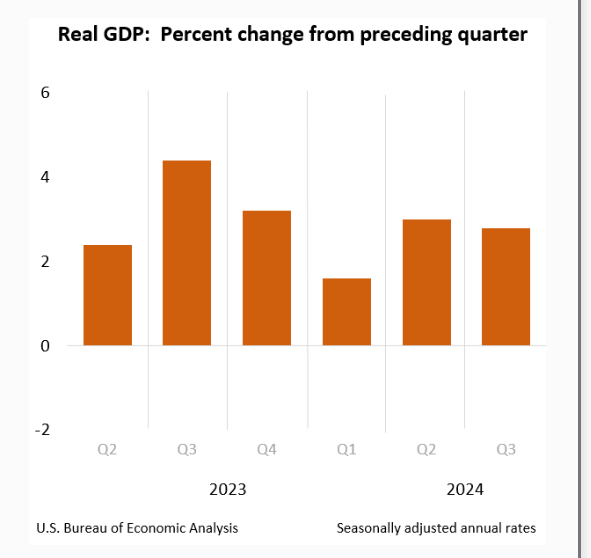
Gross Domestic Product is growing by 2.4% per year.
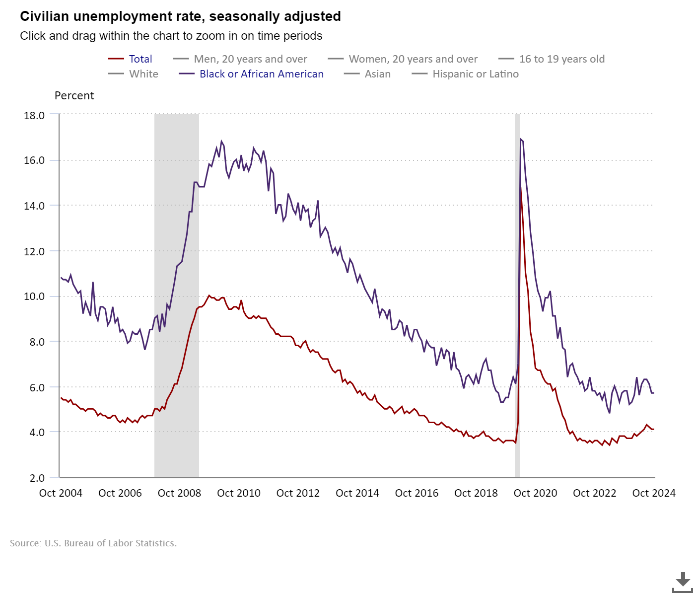
The National Unemployment rate was 4.1% in October and the Black Unemployment rate was 5.7%.
The stock market moved to a new high based on the election victory of President Donald Trump. However, other indicators are not so positive.
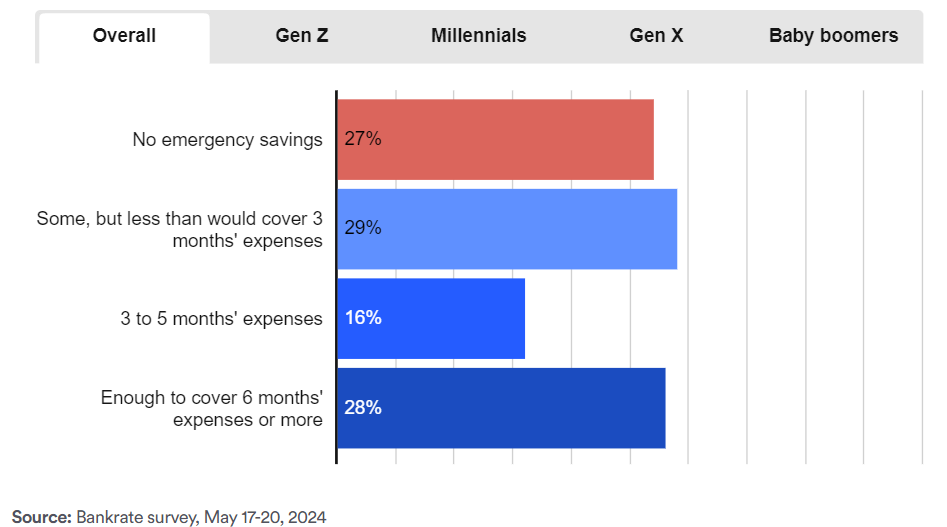
There are many data points that show the struggles of working Americans. One is the Emergency Savings survey. In the Bankrate’s 2024 Annual Emergency Savings Report (Bankrate) it was reported that 59% of people are uncomfortable with their level of emergency savings.
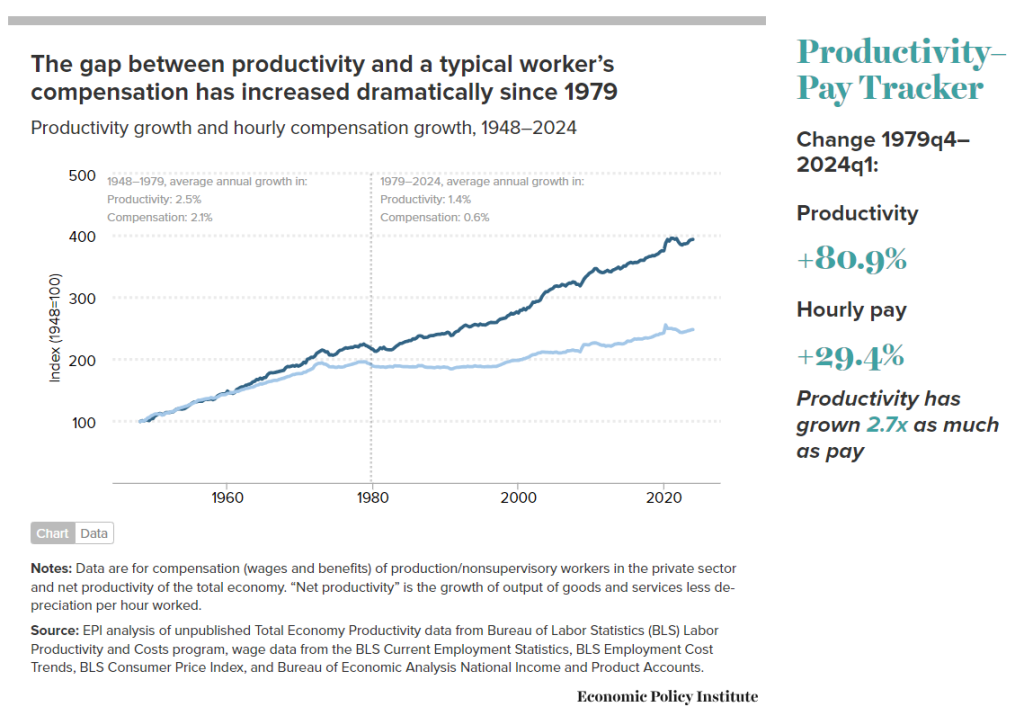
Another big one is wage stagnation from the Economic Policy Institute
There are other indictors that point to a stagnant or declining standard of living for Black Workers.
What, actually, is Trump’s Economic Plan ?
We predict Trump will do very little to alter the US economy. It’s doing great. There will be a lot of showboating and high visibility initiatives, but few real programs. Remember “Infrastructure week” during the last Trump administration. A lot of talk but few programs.
He will get Congress to pass or extend some specific programs such as the Tax Cuts and Jobs Act(TCJA) which expires in 2025. He will also eliminate taxes on tips, expand oil and gas explorations, impose minor trade tariffs on China, and stop new environmental regulations.
Immigration
Donald Trump will reform the immigration system. He has the public and congressional support to make the changes. He will deport some criminals, expand the border wall and add more border guards. He will also cut new immigration levels, reduce overstay visas, reduce the number of refugees and curtail family migration.
Trump will review immigration in areas with worker shortages like farm labor, information technology, and nursing. He may also shift to a skills-based immigration approach, like Canada, and reduce the number of H-1B visas. Congress will pass after modifications. Farms and tech companies are dependent on H1-B visa workers, so there will be a lot of negotiations.
What he will try to do
Cut the corporate tax rate to 15%.
His proposal to eliminate the tax on overtime, may pass Congress, but Congress will redefine over time to be to over 160 hours per month, rather the over 40 hours per week.
Trump will try to cut or reduce many of the Biden spending bills, which Congress passed in response to Covid-19. He will probably seek to claw back unspent funds, especially climate-related funds. During Biden’s term, in response to the pandemic, Congress passed four major spending bills: The American Rescue Plan (2021), the Build Back Better Act, the CHIPS Act, and the Inflation Reduction Act. Trump will settle for killing EV vehicle mandates and other high-profile climate-related spending like wind energy and solar subsidies.
Cut the size of the government and put his own people in charge at the top. He will ask Elon Musk to chair a task force on government efficiency.
Trump wants to cut food stamps and Medicaid, but not touch Social Security or Medicare.
What Trump won’t do
Increase housing supply. Housing supply is strongly tied to local zoning issues. Trump’s support comes from suburban voters who are opposed to changing local zoning regulations.
Trump was unable to make changes to the Affordable Care Act.
Trump will not require work permits, a national ID card, universal electronic I-9 or enforce Social Security Number fraud. Every other Western democracy has an ID card and employment verification of the right to work. He may enhance I-9 reporting which covers proper ID and reporting immigration status for workers.
Trump will not increase the national minimum wage nor support unions.
Reduce housing costs by building more housing. He is counting on low interest rates to increase housing supply, but interest rates have been at record lows for years other than during the inflation spike.
And what we will miss from Kamala
VP Harris’s loss was a chance to make big changes to the economy to benefit middle-class and working people. She could have set the economic tone for the US for four years. That is the lost opportunity.
VP Kamala Harris had a host of programs aimed at reducing the cost of living for middle-class and low-income workers. She offered child care tax credits, student loan forgiveness, universal pre-k, subsidized child care, paid sick leave and family leave, and covering home healthcare under Medicare.
Raising corporate tax rates.
And some predictions and surprises
Trump will offer token, but visible support for Black men. Trump will fund the Black men’s healthcare initiative but expand it to Hispanics.
Trump will fund HBCUs but not at the same level.
Trump will copy Harris, and increase the tax deduction for starting a new business to $50,000. The exact figure cannot be 50K, which VP Harris proposed, but he will steal the idea.
Trump’s second administration will be relatively scandal-free. Scandals took up much of the time of the first administration. They will not make the same mistake.
Trump’s Overall Economic Policies
Trump’s overall economic policy is pro-business and by extension pro-worker in a populist way. He believes that when business does well workers do well and the benefits will filter down to all workers. He will expand energy production, extend tax cuts, and reduce immigration. Reducing immigration may lead to new opportunities for US citizens.
He has no specific plans to help workers, the low middle class or the poor.
Opportunity lost
By contrast, Trump has no Black advisors. His policies will be shaped by conservative White men. Trump has one issue: immigration. Trump may have been right in running on the policy of restricting immigration. If reduced immigration ends up increasing wages and opportunities for Black Americans, then he got one, big issue right. But one issue does not qualify you to be president.
But it is also a story of what is missing and what Black people won’t have going forward. All of VP Harris’s many proposals to help Black Americans are gone. Her ideas to expand the social safety net with child tax credits and increased home ownership are gone. Black people also lost the opportunity to shape economic policy under a President Harris administration. We not have a seat at the table; we won’t be in the room and this time we aren’t even staying at the same hotel.