
Summary
Booker T Washington (BTW) was a speaker, writer, and educator in the early 20th century. He was widely considered the most prominent Black leader of his time. He met with presidents and industrialists. He believed in the uplift of Black people through self-improvement, education, and entrepreneurship. He built and led the Tuskegee Institute for 34 years.
Booker T Washington believed the best way to improve the lives of African-Americans was through education and industrial training. He was opposed to challenging the racist white political order of the time, fearing racial violence in the South.
Booker T Washington’s idea about industrial education have grown in prominence as immigrant groups have followed his path to success.
Early life
He was born a slave in Virginia and gained his freedom in 1865 as part of Emancipation. His mom moved the family to West Virginia to be with their dad, an escaped slave living in Malden, WV. Washington worked in a salt furnace and a coal mine in Malden while teaching himself to read.
Education
BTW left West Virginia with little more than his clothes and a willingness to learn. He did not have enough money, so he walked to Hampton Institute, sleeping outside. It was a journey of 200 miles. He worked his way through Hampton as a cleaner.
He was the first leader of Tuskegee Institute. He recruited students, constructed buildings and expanded the institution. As part of their education, students were expected to work in a trade for the benefit of the school.
In 1881, he moved to Tuskegee, AL to lead the Tuskegee Institute. He served from 1881 until 1915. He expanded Tuskegee from a 100-acre campus to a 2000 acre, 83 building school, with 37 majors and 1500 students. Today, there are about 2800 students.
As the leader of Tuskegee Institute, he emphasized basic skills like carpentry, furniture making, industrial arts, and agriculture.
Accomplishments and Publications
He delivered the Atlanta Compromise speech in 1895, which proposed an acceptance of segregation.
Booker T Washington wrote his autobiography, “Up from Slavery”, in 1901. It is available for free on the internet at “Up From Slavery” and “Up From Slavery”.
In 1903, he wrote an article called, “Industrial Education for the Negro,” in the book, “The Negro Problem.” The same book also included the WEB Du Bois article, “The Talented Tenth.”
He found the National Negro Business League in 1900. The organization supported Black uplift through business, entrepreneurship, economic prosperity, and social equality.
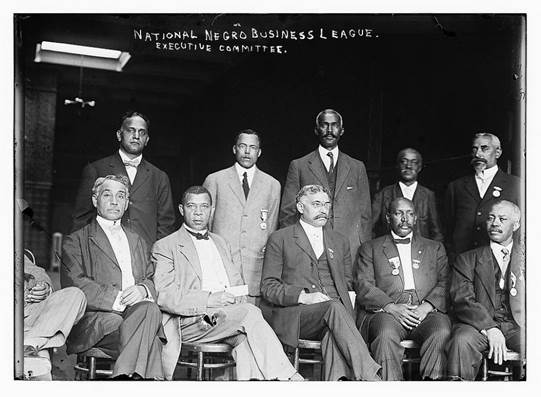
Booker T Washington associated with many of the top industrialists of the day such as Andrew Carnegie and Julius Rosenwald.
Booker T Washington’s Economic Philosophy
Washington was born a slave and was self-educated. He attended Hampton Institute and later taught at Hampton. He was the most famous black person of his time.
His economic philosophy centered around hard work, industrial education, and self-improvement. He also believed a policy of accommodation was possible with whites.
Later in Life
Booker T Washington financially supported others in the civil rights movement but did so anonymously.
BTW died in 1915.
Recordings and Quotes
There is only one known recording of Booker T Washington speaking. Someone recorded his “Atlanta Compromise Speech” and the recording is available at the Library of Congress.
It is interesting how both BTW and Du Bois spoke in a very similar manner.
Here is the text of the Atlanta Compromise Speech.
Famous Quotes
Cast down your bucket
‘A ship lost at sea for many days suddenly sighted a friendly vessel. From the mast of the unfortunate vessel was seen a signal, “Water, water. We die of thirst.”
The answer from the friendly vessel at once came back, “Cast down your bucket where you are.” A second time the signal, “Water, send us water,” ran up from the distressed vessel, and was answered, “Cast down your bucket where you are.”
A third and fourth signal for water was answered, “Cast down your bucket where you are.”
The captain of the distressed vessel, at last heeding the injunction cast down his bucket and it came up full of fresh, sparkling water from the mouth of the Amazon River.’
The ship had crossed the salt water/fresh water boundary.
“To those of my race who depend on bettering their condition in a foreign land or who underestimate the importance of cultivating friendly relations with the southern white man who is their next-door neighbor, I would say, “Cast down your bucket where you are. Cast it down in making friends in every manly way of the people of all races by whom you are surrounded.” “
Five-Fingers
“In all things that are purely social we can be as separate as the fingers, yet one as the hand in all things essential to mutual progress,”