Black unemployment jumps to 7.5%, a 23% increase since last August. New Black workers increased by 260,000.
Unemployment Report
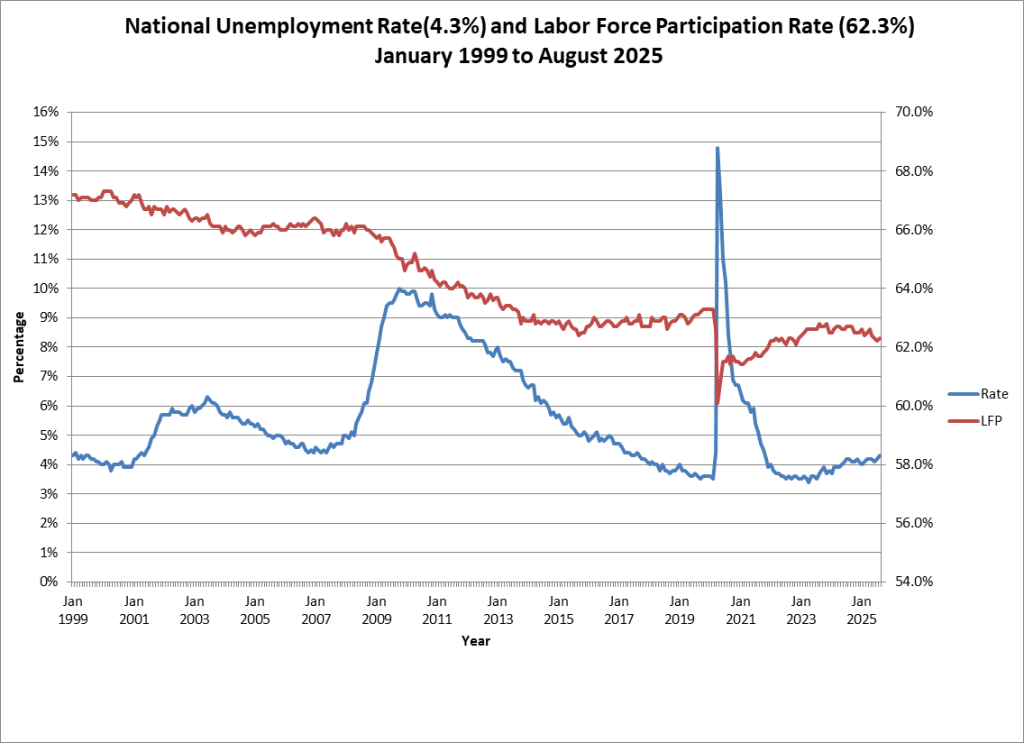
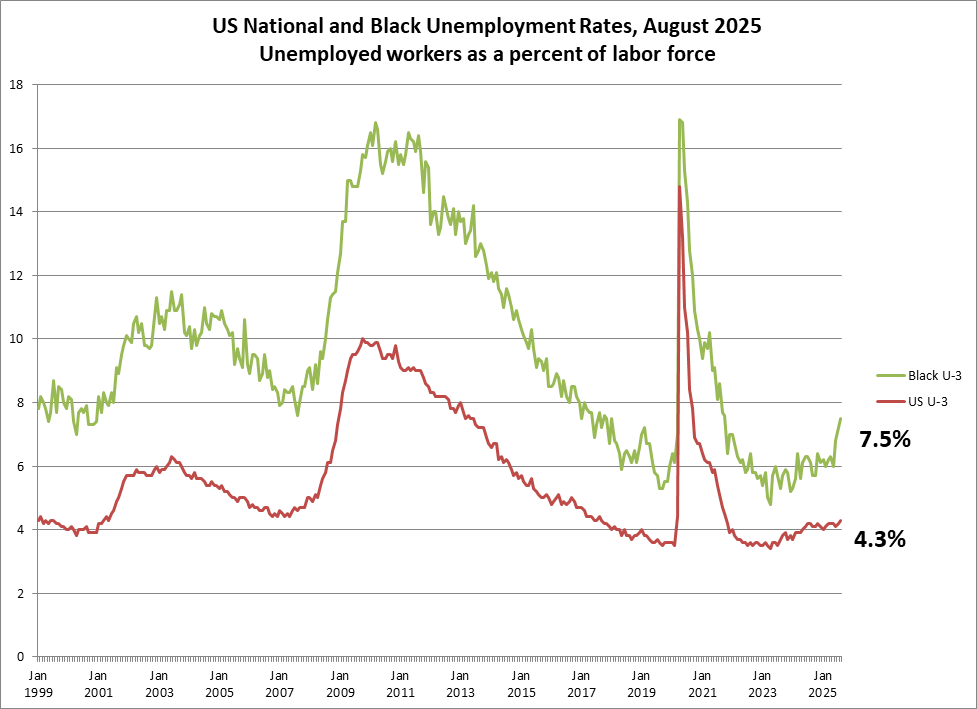
The BLS jobs report showed almost no new job growth (+22,000 new jobs) in August. Over the past three months, the economy added an average of 29,000 jobs. The numbers hint at a slowing US economy. The general unemployment rate (U-3) also increased 0.1% to 4.3%, while U-6, a broader measure of underemployment, rose 0.2% to 8.1%. The Black unemployment rate rose to 7.5% and the Real Black unemployment rate increased to 11.3%. Since August of last year, the African American unemployment rate has risen by 23%.
The unemployment report shows the US economy is slowing. Inflation was stable at 2.9%, Year over year. Many had expected an increase given the current US tariff policy. Producing countries and wholesalers absorbed most of the tariff effects. The US stock market rose as investors anticipated the low job numbers and a Federal Reserve rate cut in September.
Black Employment Numbers
Black unemployment is changing rapidly after a long period of stability post-COVID. The changes are both striking and a little confusing. While the unemployment rate is higher compared to a year ago, so is Black employment in general.
The job market is tightening as the economy slows. Black job losses often signal a slowing economy. African Americans work in key industries, like warehousing and retail, that are highly sensitive to small changes in the economy. Black employment was also affected by government layoffs and retirements. Surprisingly, tariffs have not impacted the economy.
Let’s look at some details.
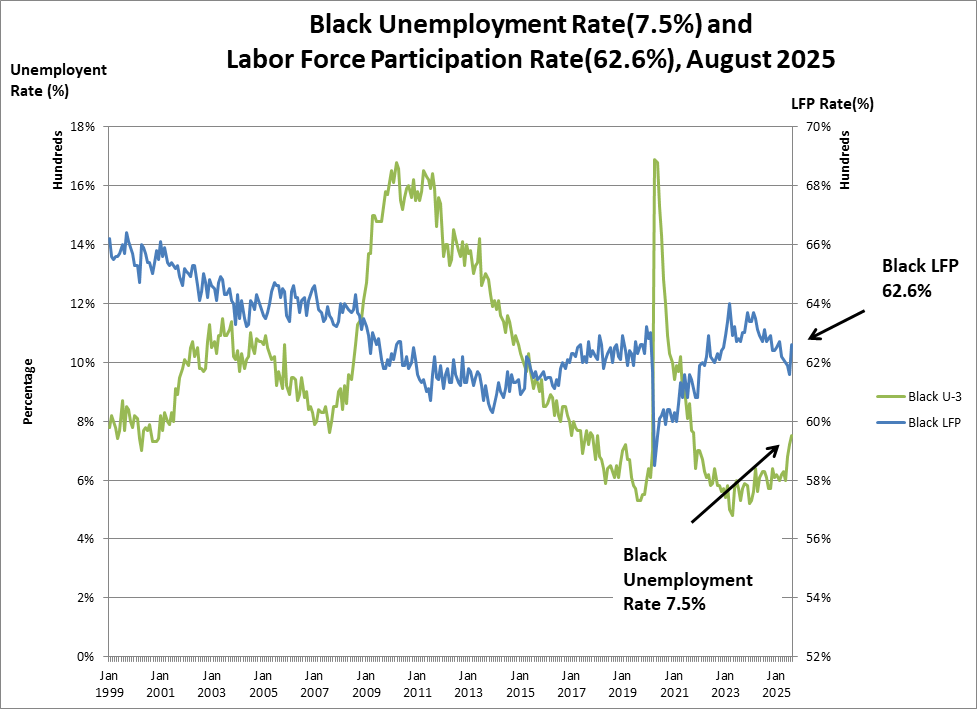
The Black unemployment rate was reported at 7.5% in August by the Bureau of Labor Statistics. Black unemployment has increased by 1.4% since August of last year. The rate of change is an alarming 23% increase compared to the same time last year. However, there are other signs of improvement, such as 260,000 (260K) more African Americans working in August as compared to July.
The average Black unemployment rate had been relatively stable (5.9%) over the past 24 months before the jump to 7.5% in August.
More Black people are working
In August, there were 360,000 more African American workers. About 260,000 found jobs and 100,000 registered as unemployed. The change both increased the Black participation rate to 63% but also pushed up the Black unemployment rate (7.5%). The good news: the number of African Americans participating in the job market has increased. The bad news: when they can’t find a job, unemployment also increases.
Black female employment was flat with a small change of +13,000. Black women’s unemployment also rose by +45,000, a 6% increase. Black male employment increased by 3% (270,000) from 9.62 million to 9.89 million. The number of unemployed black males added a small number: 30k. Black teenage unemployment moved up by +25,000.
The “Real” Black employment stood at 11.3% (see chart below). The Discrimination ratio, which is the number of unemployed Blacks compared to unemployed Whites, increased to 1.7.
Related Economic News
The small increase in workers shows that the US economy is slowing. The job market remains difficult for new college graduates. The financial community expected the report, and the stock market continued to rise to all-time highs. The S&P 500 index was recorded at a new high of 6584. The S&P 500 index is widely viewed as the best index of general investor sentiment. Politicians and investors are waiting for the Federal Reserve Board of Governors meeting on September 16th and 17th, 2025. The Fed is expected to lower interest rates by 0.25%. Inflation was little changed at 2.9%.
Business Employment
Total non-farm payroll reported a small gain of +22,000, continuing the four-month trend of slow hiring since June.
Some sectors continued to add jobs. Health care added 47K, Leisure and hospitality tacked on 28,000, and retail trade increased by 10,500 positions.
However, there were many job-losing sectors. Business services were down -17K jobs, the Federal government lost -15,000 workers, construction was down -7K jobs and manufacturing shed -17,000 jobs.
Wages rose by 3.7% annually (0.3% in August). Inflation was measured at 3.0%.
Businesses often report their results late, leading to revisions. After last month’s report, President Trump fired the head of the BLS in response to lower job numbers. The commissioner only reports results to the president and is not involved in data collection. June employment was revised down by -27,000 and July up by +6,000.
The National unemployment rate stood at 4.3%; and non-farm Payrolls rose by 22,000. Hourly wages increased by 3.7%.
The jobs report, also known as the Employment Situation Report, is collected and published by the Bureau of Labor Statistics. It consists of two reports: one surveying individuals, the population survey and the second, the business survey report where businesses describe their employment patterns.
The ADP unemployment report showed that private employers added +54,000 jobs in August. The Paychex Jobs index was unchanged (-0.01) in August. It is down -0.06 over the past 12 months.
And now for some important charts.