
Or more than you ever wanted to know about Black Doctors in the US
Introduction
We want to explore the current state of Black physicians in the United States in 2025. We estimate there are apporximately 75,000 Black doctors in the US in 2024. (BlackEcononmics.com)
Black doctors are vital to the Black community for four key reasons. First, they provide better health outcomes—Black patients are healthier and live longer with Black doctors. Second, Black physicians are more service-oriented. They choose to practice general medicine rather than high-paid specialties. Third, as top 1% earners compared to the general Black population, they wield significant economic power. Finally, they serve as mentors and role models, inspiring others to pursue careers while serving in their communities.
Let’s dig into the Black Physicians in the United States
First, African American physicians provide better health outcomes for Black patients. Numerous studies have shown that Black patients do better with Black physicians. Studies have shown that patients visit their doctor more frequently, practice greater preventive care, follow treatments better, and have a lower number of emergency room visits. (KFF)
Second, African American physicians benefit society. Black doctors are more service-oriented as physicians. They specialize in healthcare fields that help the largest number of people and Black people, such as general practice, obstetrics and gynecology, and public health.
Third, they are upper-income earners with significant economic power and influence that benefits Black people economically. Black Physicians are in the top 1% of all Black income earners. They earn on average $256,000 dollars per year.
Fourth, they are role models: for other Black kids and the larger society. They often inspire and mentor other Black doctors and future doctors. They also provide examples of Black excellence to the larger white society. There is a reason why Dr. Cliff Huxtable (the Cosby show) and Dr. Julius Hibbert (the Simpsons) were Black.
Finally, Black physicians have made one of the best career choices available in the US in the 2000-2025. There is a huge demand for Black doctors. Like teachers, doctors are doing good for society and helping people. Black physicians can sleep good at night. The pay is in the top 1% of all Black workers. And the hours are flexible and employment is secure. Doctors have close to a zero unemployment rate.
It is important to mention that there is a shortage of Black Doctors compared to the general population. Many black communities are served by other ethnic groups for general medical services, while corporate medical institutions, health networks, and hospitals have been slow to hire Black physicians.
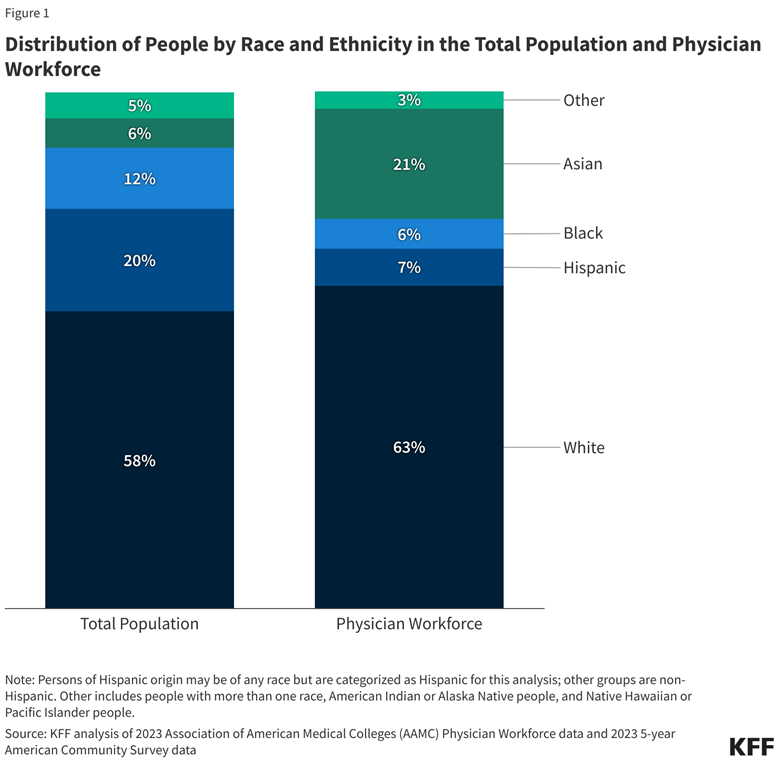
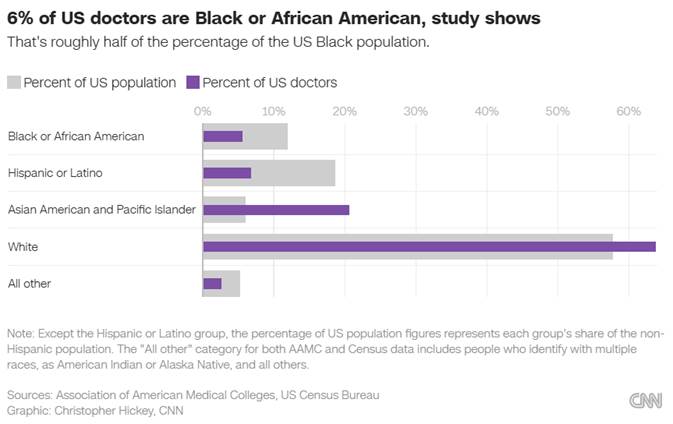
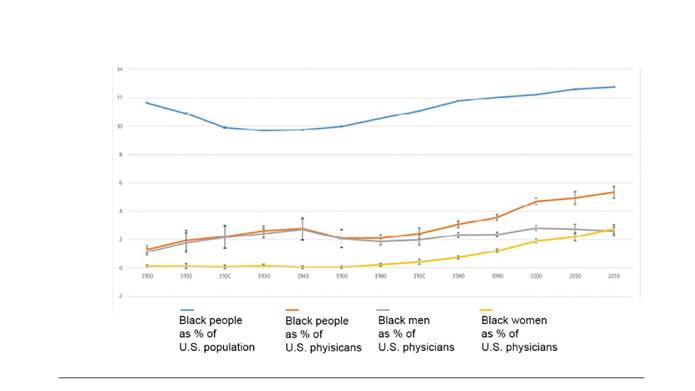
We want to start with some basic facts about Black Physicians. Black Doctors are underrepresented compared to the general Black population. And they have been historically. About 5% of all doctors identify as Black, while the general population is 13% Black. The number of Black female physicians has also increased dramatically, mirroring trends in the general physician population.
The number of Black doctors has grown significantly over time, but has plateaued since about 1990 when compared to the general population. There is a clear immigration effect, which is seen in the rapid increase in Asian doctors after the landmark 1968 immigration bill (Hart-Cellar Act) which abolished national quotas. The number of Hispanic doctors has also stopped growing.

The number of Black Doctors has grown significantly since 1890 and accelerated since 1970. The largest gains have come during the 2000s.
Black Doctor Data Discussion
We want to spend a moment discussing the actual data, because it is so important and so hard to come by. There is a lot of work in this simple chart. As far as we know, this is the first data set of fully sourced, Black Physician data available to the public in one place. The data comes from four sources: the Negro Yearbook(NYB), the American Association of Medical Schools (AAMS), the US census (10-year census), and the Current Population Survey (CPS) of occupational data.
The negro yearbook was used for datapoints between 1890 and 1940. The decennial census for 1940 to 1970. And the CPS has produced estimates since 1972. The AAMS has produced recent estimates.
The chart has few data points between 1890 and 1970, but then gets more accurate after 1972. Between 1972 and 1981 we have estimated Black doctors at about 3%. A detailed note in a separate post explains the sources and our methodology for constructing the data series.
The earlier data comes from Monroe Work’s Negro yearbook. The NYB covers the years from 1890 to 1942. But it reports every 10 years, and it reuses previously collected data. Between 1940 and 1970, we used the 10-year (decennial) census.
In 1981, the US census broke out Black physicians as a separate category. However, the category is called “Black and all other,” hiding Hispanic, Asian, and immigrant doctors. The number of Asian and Hispanic doctors greatly increased after the immigration reform act of 1968. In 1982, the Census added the Hispanic category. Finally, in 2002 they added Asian doctors. So the data gets more accurate from 2002 onward. Since, 1983, Black doctors have remained a distinct category with the exception of 1972 to 1981.
Patients with black doctors have better health overall
There are several studies showing that health outcomes are better for Black patients with Black doctors. Studies have shown that patients visit the doctor more frequently, practice greater preventive care, follow treatments better, and have a lower number of emergency room visits. (KFF) Here are three of the more prominent research papers.
In the fact-based world of economics, it is hard for us to actually prove what may be obvious to a regular person: Black patients with Black doctors do better. Black doctors care more about Black patients, listen more and prescribe treatments more suited to Black people. And Black patients are more open about health issues with Black doctors and follow treatment programs.
Economic Impact of Black Doctors
Black Physicians have a big economic impact in the Black community. Black physicians earned about $313,000 a year in 2022 (Medscape), Page 9. Medscape also shows Black Physicians earn about 11% less than their White counterparts. The NAICS has a mean wage for Physicians (29-1210) of $276,650 in 2024. (NAICS). And the ACS 2023 has mean earnings for other physicians at $241,630. So, about 75,000 black physicians collectively earn between $18.1 and $23.5 billion dollars.
That is about 1.5% of all the money Black people earn in the US. Black doctors are the highest-earning large group of people (greater than 50,000) in the United States. Sorry, CEOs, entertainers, and athletes, you’re fun to follow on social media, but economically, you don’t really matter.
All that Black income leads to Black controlled spending. Doctors buy real estate, cars, vacations, and education for their children. They invest and save. Just for some context, Black nurses earn close to $60 Billion dollars (5% of all Black income), but there are 10 times as many Black nurses.
That’s the good news. The bad news is that the economic impact of Black doctors has decreased over time. Gone are the days when a Black doctor owned many properties in a Black neighborhood or loaned money for new businesses. The spillover effect of Black Physicians has greatly decreased after integration, but is still significant.
Role models and social benefits
Black doctors are role models, whether they like it or not. They inspire others to take care of the Black community and earn money. Most black medical students credit someone who took an interest in them in high school or college, and said they should think about medicine as a career. This long-term impact is hard to quantify, but may be the second most important effect after health outcomes. They provided a path to the future for young people struggling with career decisions. The Pact: Three Young Men Make a Promise and Fulfill a Dream
Medicine as a Black Career
Black medicine is a great career choice. As we are fond of saying here at Blackeconomics.com, look at “meds and eds”. Healthcare and education has been the biggest middle class income drivers of the past 40 years. Anyone can do it, but the initial investment is larger in both time and cost, however the payoff is huge. You are helping people. You have flexible hours and high incomes.
The Black doctor shortage is real. We are missing 40,000 black doctors.
The shortage of black doctors is a real problem. The shortage affects many different areas of society, but most importantly, Black life expectancy. The discrimination against Black doctors has widely affected society, as we have previously discussed.
Like everything else we discuss at BlackEconomics.com, the Black physician shortage is a real and complex problem. There are three components to the Black doctor shortage: a shortage of Black doctors compared to the general population, a shortage of doctors compared to other countries, and a “Missing Black Doctor” problem.
Missing Black Doctors due to historical discrimination can be further broken down into three more pieces: the forced closure of Black medical schools during the early 19th century, limited access to white medical schools, and sexism limited the opportunities for women to become physicians.
The American Medical Association harmed Black healthcare in the US for decades
Finally, we want to close with the historic apology of the American Medical Association (AMA) in 2008. The AMA acknowledged the harm done to Black physicians by their organization.
“This is also the moment we can stand as one, in tireless advocacy for diversity in health care,
especially within the physician population, that, at a minimum, reflects the diversity we see
among those who need care”
Summary
Our research estimates that if the US had created Black doctors at the same rate as white doctors (Long-Term Economic Structural Bias Rate(LTESBR)(or Black Poverty Rate)), there would be an additional 40,000 an additional 40,000 African American physicians in the United States. Black life expectancy would increase. And those Black doctors would generate an additional $20 billion in Black income.
There are additional spill-over effects in related professions such as nursing, wealth effects ( real estate, education, and business) and education and opportunity effects.
Not educating Black doctors has worsened society in the US for us all.
End of Introduction
======================================
Black Doctors in the United States — detailed data discussion
Determining the actual number of Black Doctors in the United States is difficult because the data is not up to date, US census categories change, and the data comes from many different sources. However, since this is an economics blog, we are going to give our best three estimates and see if they correlate.
We estimate there are 75,000 black doctors in the United States or about 6.7% of all doctors in 2024.
Please read our detailed post here, which explains our estimate. Plus, it includes our spreadsheet of data and the data source underlying our estimate.
————–
Kaiser Family Foundation (KFF) has an excellent chart comparing the total Black population to the number of Physicians.
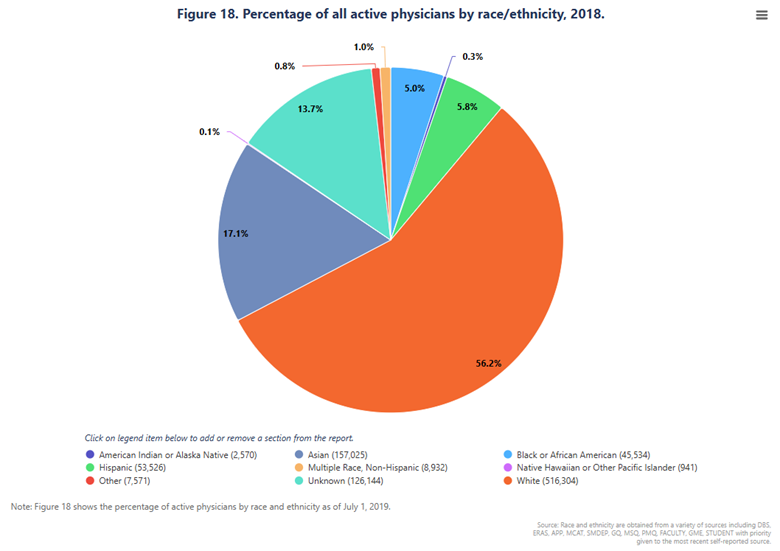
The Association of American Medical Colleges (AAMC) has a widely used chart from 2018 that shows 5.2% of physicians in the US were Black. In the report, “Diversity in Medicine,” they estimate there were 45,534 Black doctors in 2018.
The news outlet, CNN has a great graphic summarizing the issue which is shown below. (CNN)
And, finally, in 2021, Dr. Dan Ly, from UCLA, has also researched the number of Black physicians in the US. (UCLA) and found in 2018 5.4% of physicians were Black.
End Part 1.
Version 12.3