
Black Economics unemployment report review for September
Black employment and unemployment
The report is another in the continuing list of reports showing poor labor market performance by Black American workers. So, pick your statistic: 7.0% Black unemployment(+1.0%), a downward revision of 60,000 jobs, or wage growth of 0.1% this month (1% YoY). Then add small employment increases in the “Black” sectors of the economy where African Americans work: retail, logistics, healthcare, and government. And you get a grim picture of current African American employment.
But it gets worse: There are three large downward trends for Black employment that we want to look at a little deeper.
First, in a stagnant job market, there is still churn. Workers get jobs and workers leave. New people join the labor market, and others retire.
Even in a frozen job market, someone wins, and someone loses. And the winner has been corporations. When there is little increase in new jobs, the supply of jobs becomes tighter and “good jobs” rarer. There is increased competition. Big companies use the frozen job market to cut costs by reducing pay and benefits and lowering job quality. Corporations control 50% of employment and 15% more of related employment.
Second, the current presidential administration does not acknowledge a jobs issue. And neither does Congress. The one major piece of legislation, the OBBBA act, HR 1, made major reductions in social spending while continuing tax breaks for the wealthy.
And third, the demographic changes in the workforce show a slow replacement of White and Black workers with Asian and Hispanic workers. No one wants to admit a Zero-Sum Society, but everyone knows about the daily competition for good jobs.
We’re lucky we can discuss race, immigration, and foreign-born workers while the mainstream media cannot.
But let’s cover the basics before we get to the large demographic changes in the report and the effect on black workers.
Black Employment News
The Black unemployment rate rose to 7.0%, an increase of 1.0% in September, the largest increase in 12 months. It is still down from 7.6% a year ago.
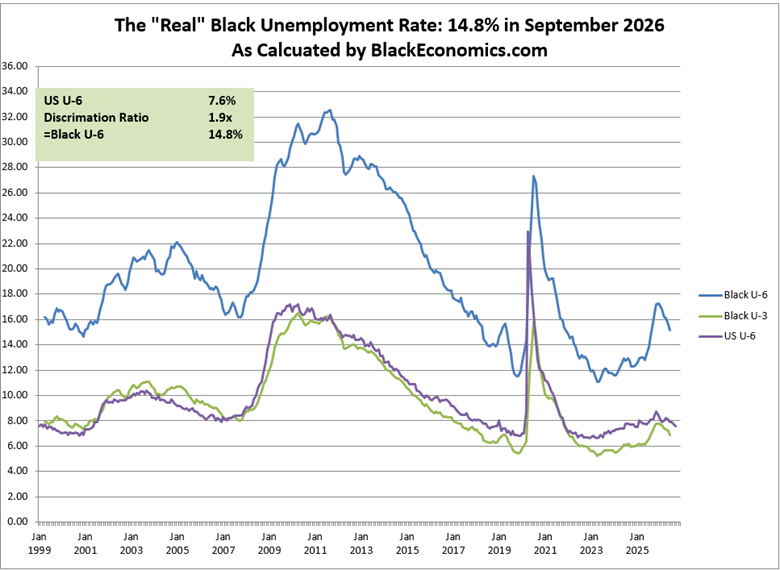
The Black unemployment rate can move around quite a bit, but the longer-term trends are captured. And when you add U-6, everyone who wants a job, you get a better picture of Black unemployment.
Many of the key sectors where Africans Americans work had small employment gains: healthcare, retail, wholesale, logistics, education, and government had small increases in total employment
And as always, we will calculate the Real Black Unemployment rate.
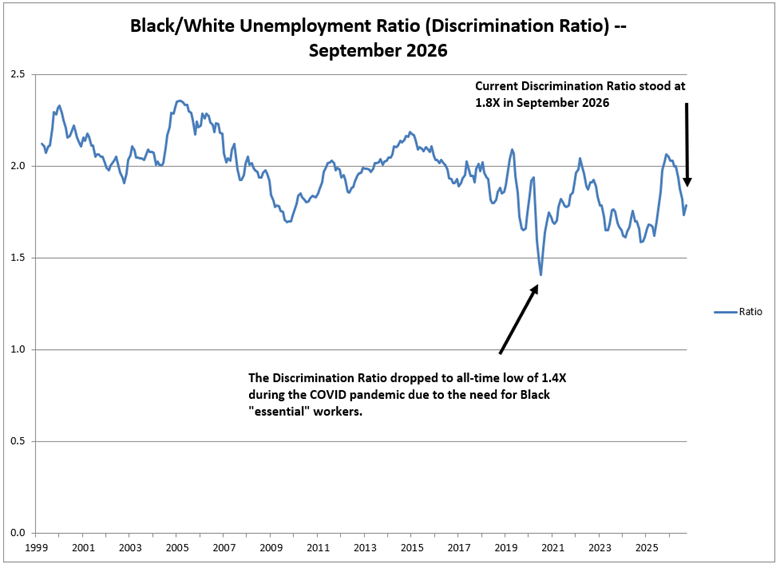
And the employment discrimination ratio. The discrimination ratio measures the difference between the Black unemployment rate and the White unemployment rate. 2x means black unemployment is twice as high as white unemployment.
Unemployment report details
The unemployment rate, U-3, rose from 4.1% to 4.2%, largely because employment(+406K) did not keep up with the labor force (+485K). Nonfarm payrolls increased by +29,000, with small gains in healthcare, construction, and manufacturing offset by declines in business services. Healthcare had modest growth (+23K).
Market Reaction
The stock market reacted positively, moving up. (SP 500 +0.75%). The bond market was mixed, but did not anticipate another rate rise to curb inflation. Interestingly, the market no longer reacts to the labor report and has also factored in the frozen job market. The media does the same with scant coverage of the labor market.
However, in this report, we want to look at two larger ongoing trends:
AI and gig worker watch
We keep a close eye on two key and underreported sectors in the job market: AI targets and Gig workers. Both provide insight into the future of the job market in the US.
AI-affected employment was down slightly but continues an ongoing trend. We look at workers who are highly vulnerable to AI.
Business Services(-9K), Legal,(+2K), insurance(-2K), finance(-7k), and IT(-10K) were all flat or down.
Demographic trends
The job market at a national level is completely stagnant. But beneath the statistics, there is churn. Here are some key demographic trends to watch. In a frozen job market, workers leave and are replaced. Job turnover continues, but at a slower rate. The Job Openings and Labor Turnover Survey (JOLTS)
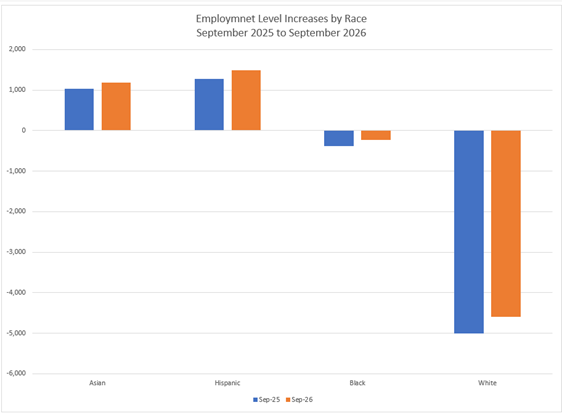
Missing in the jobs discussion is the huge number of Asian and Hispanic workers entering the job market. The numbers show us that Hispanic and Asian workers are slowly replacing white and Black workers in many fields and sectors of the economy.
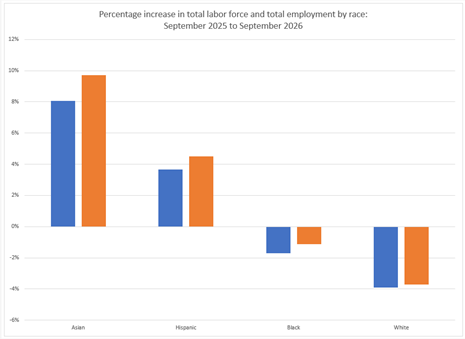
You can see this trend in the civilian labor force statistics (BLS) in the current jobs report. One of the most notable is the number of new Hispanic and Asian workers in the past year. The number of Hispanics joining the labor force increased by 4% or 1.2 million Year over Year (YoY). Asians had similar increases in employment (8%) at 1 million. When you compare Black workers (-386,000 or a -2%) and white workers(-5 million, 4% drop), the numbers are staggering.
The numbers in the labor market and employment figures have jumped, while white and black stay stagnant.
When you analyze the percentages, they show the same trend.
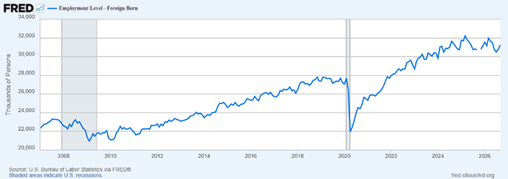
Second is the number of foreign-born workers has slowed recently.
Discussion
So, for the first time in a while, no one seems to care about the Black unemployment rate. President Trump’s relentless racial attacks, anti-black policies, and anti-diversity, equity, and inclusion rhetoric have allowed corporations and the American people to look the other way.
The stagnant job market raises larger issues (Quiz): Is a recession on the way? Is AI affecting the job market?, Do we need a jobs program?, And how much of the growth in the economy actually trickles down to benefit the average worker?
If your answers were: Not likely, Slowly, Yes, and None, Little or Small, you passed today’s quiz.
So we are stuck(“Frozen”) at the same place. Asking the same questions. One, what are the US growth and taxation policies that are best for black people economically? Two, how large is the effect of immigration on black employment?
Summary
Just another bad report. The downward trends continue. Without some political action, Black people will continue to bear the brunt of the stagnant job market.
The shifting demographics show a disturbing long-term trend toward replacement and increased competition. None of this bodes well for the economic security of African Americans
——-
Note: when we talk about replacement in the US labor market, we are talking about facts and what is actually happening, not replacement theory, a debunked conspiracy idea, which is defined as the government’s or corporations’ planned replacement of existing workers by design.
There is little evidence that any of our immigration policies were by design; instead, it was businesses’ demand for lower-cost labor that created the current US immigration policy in a vacuum. Basically, our immigration policy was developed by US corporations chasing lower labor costs.
Second: Blackeconomics.com does support immigration. But at levels that would help Black people in the US and immigrants and refugees build a better life. There should be a balance that helps everyone. We must improve the economy while balancing US strategic interests, both foreign and domestic. Second, we have an obligation to help immigrants and the countries they come from while, at the same time, considering the employment needs of the US economy and African Americans. Unfortunately, African Americans were left out of the debate.